
Review · BARCELONA
Gothic Quarter Insights & Tapas Experience
Barcelona’s oldest quarter rewards slow footsteps. I like how this tour links Roman columns, medieval palaces, quiet squares, and working streets into one clear route. I also like the simple finish: one pintxo and one drink, served after the walk. The main drawback is that the tour covers a lot of ground in about two and a half hours, so the brief stops are mostly for explanation and photos rather than long visits inside buildings.
This is a useful first-day tour, especially if you want to get your bearings before exploring the Gothic Quarter alone. The 3:30 pm start leaves your morning free, but the route is still a serious walk on old streets and stone pavement. Wear comfortable shoes, and do not expect a full meal or a guided visit inside every church and monument.
Key points about the Gothic Quarter walk
- Roman Barcelona appears early: Plaça Nova and the Temple of Augustus give you a direct look at the city’s ancient foundations.
- The route favors atmospheric places: Plaça Sant Felip Neri, Placeta del Pi, and Carrer de Montcada show quieter corners beyond the main tourist paths.
- The 3:30 pm departure works well: You can use it as a gentle introduction after arriving in Barcelona or after a morning at another sight.
- A drink and pintxo finish the outing: This is a small food stop, not a tapas dinner, but it gives the walk a social ending.
- Groups can reach 20 people: Some departures are much smaller, while a full group may make narrow streets and questions less personal.
- The guide makes the difference: Past departures have featured guides named Ariana, Leah, Núria, Maria, and Germans, with praise for warmth, humor, and local knowledge.
Why this route works for a first look at Barcelona
The Gothic Quarter can feel confusing on your own. Streets twist, buildings change style without warning, and a Roman column may sit behind an unmarked doorway. A good guide gives you the sequence: Roman colony, medieval church power, royal Barcelona, merchant wealth, and modern city life.
That sequence is the real value here. You are not simply checking off nine locations. You are learning how Barcelona grew inside and beyond its old walls.
The route is offered in English, with multilingual guiding listed in English, Spanish, French, and Italian. The tour is designed for a group of no more than 20 people, though some past departures were much smaller, including groups of four, seven, and eight. A smaller group makes it easier to hear on narrow streets and ask questions.
The total price is $54.06 per person. That is fair if you want a hosted introduction, historical context, and a drink with a pintxo at the end. It is less attractive if you only want to wander the quarter, since most of the sights are free to see from outside. You are paying mainly for the guide’s explanations, route planning, and company, not admission tickets.
More Old Town Tapas Walks in Barcelona
- Barcelona Gothic Quarter Tapas & Taverns Food & Wine Tour
★ 5.0 · 1,470 reviews - Barcelona: El Born and Gothic Quarter Wine & Tapas Bar Tour
★ 4.8 · 674 reviews - Barcelona Old Town Tapas Tour: Vermouth, Bites & Hidden Gems
★ 5.0 · 627 reviews
Plaça Nova and the Roman roots of Barcino
The walk begins at Lamaro Hotel Barcelona on Av. de la Catedral, near Plaça Nova. Look for the guide at the meeting point at 3:30 pm. One past departure was hard to spot because a street fair was being set up, so arriving a little early is sensible.
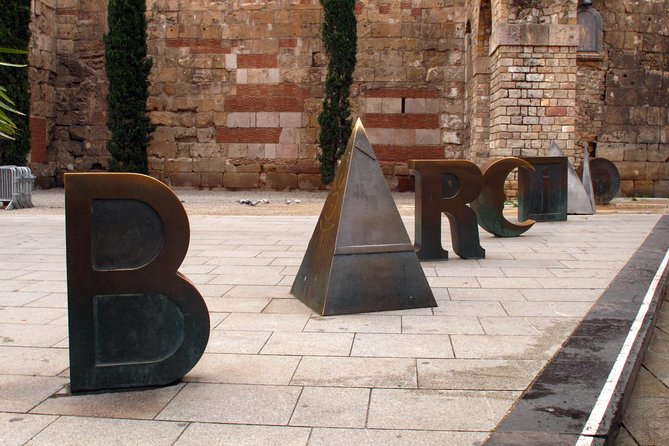
Plaça Nova is a strong opening scene. Seven large letters spell Barcino, the main ancient name connected with the Roman colony that became Barcelona. The installation was created by Barcelona-born artist Joan Brossa, with six bronze letters and one aluminum letter fixed to the ground.
This is a clever first stop because it puts old and new Barcelona together. Behind the contemporary artwork are traces of the former Roman city wall. You get a quick lesson in the city’s earliest name, then a visual reminder that the Gothic Quarter is not only medieval.
You spend about 10 minutes here. That is enough for the guide to explain the Roman setting and for you to take photographs, but not enough for a detailed study of the surrounding remains.
Barcelona Cathedral and the old episcopal center
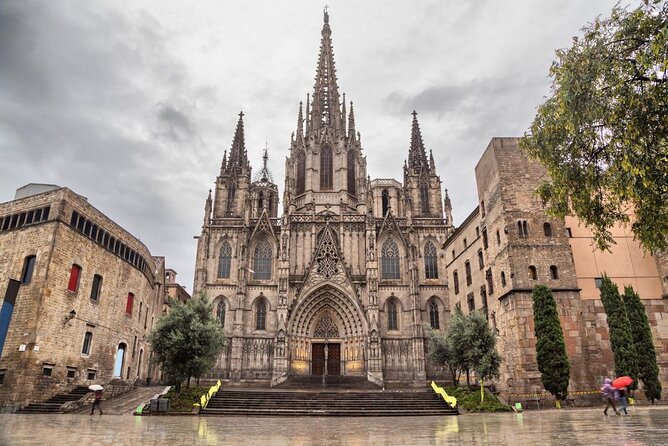
The next stop is Catedral de Barcelona, officially the Cathedral of the Holy Cross and Saint Eulalia. The provided route description also refers to the area around the former Roman wall and the opening of Plaça Nova in 1355, when buildings were removed and water channels were redirected.
The key point is location. This was a religious and civic center inside the city walls, where later Barcelona was built over Roman foundations. Your guide can help you read the layers instead of seeing only a grand Gothic facade.
The stop is listed as five minutes, so treat it as an outdoor orientation rather than a cathedral visit. No admission ticket is included, and the tour does not promise entry inside. If the cathedral is high on your list, plan a separate visit.
Casa de l’Ardiaca and a glimpse of church power
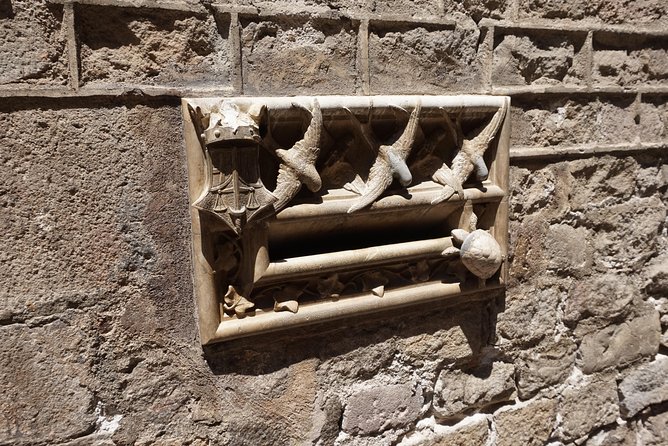
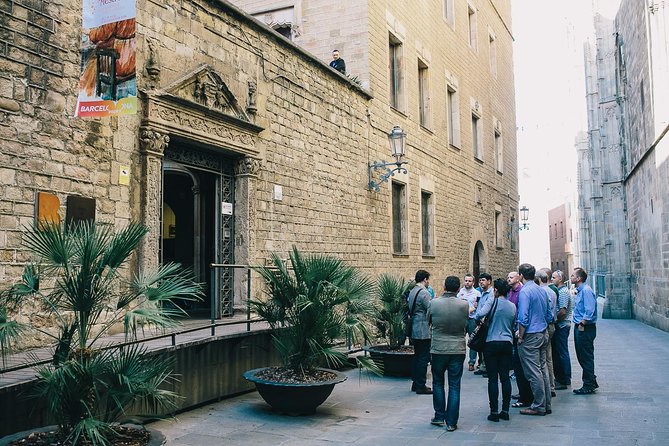
Casa de l’Ardiaca gives you a more intimate architectural stop. It served as a residence for church officials from the 12th century and changed over time. Alterations in the early 16th century connected it with the dean’s residence, while a porticoed courtyard and Renaissance details were added to the original Gothic structure.
The building is interesting because it is not a single clean period piece. You can see Gothic forms mixed with later decoration, a common pattern in an old European city. A staircase leads toward an upper terrace with a balcony often compared to a Romeo and Juliet setting.
You get around 10 minutes here. That gives the guide time to point out details that are easy to miss, especially if you walk past without knowing the building’s former role.
Same city, a different plate:
- Montserrat Half-Day Tour with Tapas and Gourmet Wines
★ 5.0 · 7,359 reviews - Montserrat & Cogwheel Train, Gourmet Wine Tasting & Tapas/Lunch
★ 5.0 · 6,290 reviews - Barcelona Tapas and Wine Experience Small-Group Walking Tour
★ 5.0 · 5,804 reviews - Montserrat with Black Madonna & Medieval Winery with Tapas/Lunch
★ 5.0 · 5,209 reviews
Plaça Sant Felip Neri, the quietest pause
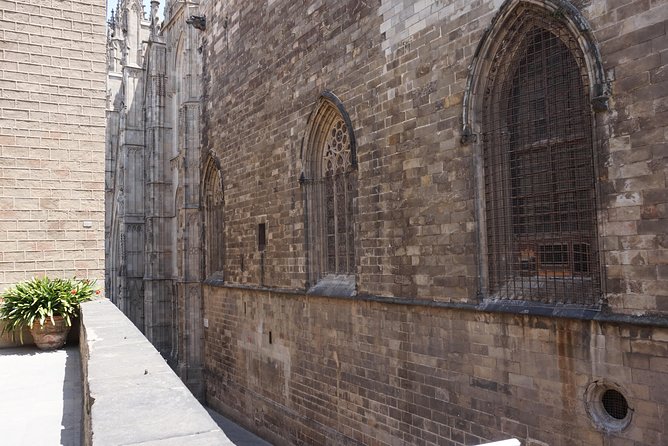
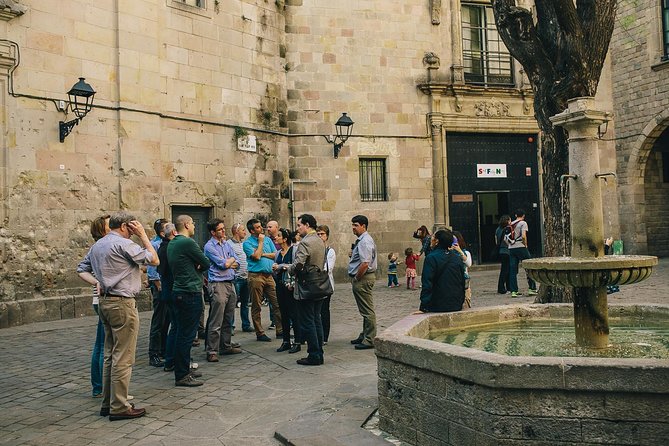
Plaça Sant Felip Neri is one of the most memorable spaces on the route. Narrow streets suddenly open into a small square with a fountain, overlooked by the Baroque church of Sant Felip Neri.
The square also connects with Barcelona’s old guild life. Buildings once housed the shoemakers’ and coppersmiths’ guilds after they moved from other streets in the quarter. This detail helps you picture the Gothic Quarter as a place where trades, churches, homes, and political power occupied the same tight neighborhood.
The 10-minute stop is short, but the square rewards a pause. It is a good place for photographs and for listening to the guide’s account of how the quarter’s small spaces were used.
One caution: this is a narrow, enclosed part of the route. A group of 20 can feel large here, especially if other people are passing through. Stay close enough to hear the guide.
Placeta del Pi and the old church cemeteries
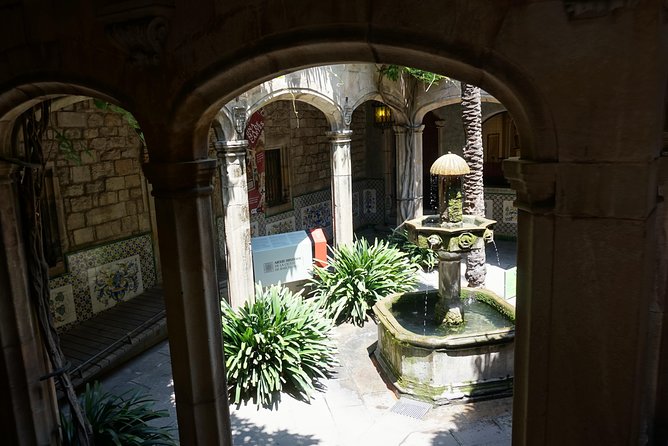
Placeta del Pi surrounds the Gothic Basilica of Santa Maria del Pi. The church and the nearby small squares create one of the quarter’s most appealing corners.
The squares were once cemeteries beside the 14th-century church. Today, painters and artisans use the spaces to display their work. That change gives the stop a useful contrast: a place once shaped by religious burial customs now functions as a public meeting and market area.
Again, the tour gives you about 10 minutes. You will learn the setting and have time to look around, but this is not a slow church tour. If you enjoy religious architecture, note the basilica so you can return later.
Plaça del Rei and medieval royal Barcelona
Plaça del Rei is the grandest historic ensemble on the route. The square is enclosed by the Palau Reial Major, or royal palace, and related buildings. Together they offer one of Barcelona’s clearest views of its medieval courtly past.
The square has a different feel from the smaller lanes and parish spaces earlier in the walk. Here, the scale is more formal. Royal power, administration, and ceremony replaced the crowded feel of workshops and local guilds.
The stop lasts about 10 minutes. That is enough for a useful explanation of the buildings and their place in medieval Barcelona. It is not enough to explore the museum complex in detail, so consider this a preview rather than a substitute for the Museu d’Història de Barcelona.
For history lovers, this is one of the tour’s most valuable stops. For younger visitors, the guide’s stories may be what makes the palace more than an attractive stone backdrop.
The Temple of Augustus behind Carrer Paradís
The MUHBA Temple d’August is one of the route’s best surprises. Four columns from the Temple of Augustus survive inside a small medieval courtyard on Carrer Paradís. They are more than 2,000 years old and connect directly to Roman Barcelona.
The setting matters. You do not encounter a huge open ruin. Instead, ancient columns appear inside a much smaller urban space, surrounded by later buildings. That makes the city’s layers easy to understand: Roman remains were not preserved in isolation but absorbed into the medieval neighborhood.
The stop is scheduled for 10 minutes. You will have time to see the columns and hear how they relate to Barcino. If the doorway is busy, listen carefully, since the group may need to keep moving.
This is also a good example of why a guided walk helps. Without context, four columns can seem like an isolated fragment. With the story of Roman Barcelona, they become one of the clearest links between the modern city and its beginning.
Santa Maria del Mar and the people of the old city
The Basilica of Santa Maria del Mar brings the walk toward the southern side of the old quarter. It is known as a major example of Catalan Gothic architecture and is sometimes treated as the real cathedral of the old town because local residents helped build it during the medieval period.
The church has a different character from Barcelona Cathedral. Here, the focus is strongly tied to the neighborhood and the people who lived and worked around it. That makes the stop useful for understanding medieval civic life, not only religious power.
You get approximately 10 minutes. The tour does not include admission, so you should not count on an interior visit. If you want to see the basilica inside, set aside separate time.
The location also helps connect the Gothic Quarter with the Born district and the old waterfront area. The route is becoming more open as it moves from the cathedral quarter toward the former merchant streets.
Carrer de Montcada and medieval civic wealth
Carrer de Montcada is the final listed stop. Today, it is one of Barcelona’s most important streets for medieval civic architecture. It runs from the Romanesque Marcus chapel toward Plaça del Born and was once a single street before Carrer Princesa divided it in 1853.
The name comes from the powerful Montcada family. According to the historical account given for the route, the family received land in the 12th century connected with support offered to King Ramon Berenguer IV during the conquest of Majorca.
This street changes the story again. Earlier stops focus on Roman foundations, bishops, kings, and parish churches. Carrer de Montcada brings in aristocratic and merchant power, shown through grand residences and civic buildings.
You spend about 10 minutes here before the food stop. The route gives you a useful overview, but anyone interested in the palaces and museums along the street should return at a slower pace.
The pintxo and drink at the end
The food portion is modest but welcome. One pintxo and one drink are included, usually at a bar after the walking section. A pintxo is not exactly the same as a broad tapas meal, and this tour is not designed to replace dinner.
That distinction matters. If you arrive hungry, eat something beforehand or plan dinner afterward. If you want a small taste of local bar culture and a chance to chat with the group, the finish works well.
Past departures describe the food stop as a perfect ending, with beer and tapas or a pintxo and drink. One guide even helped a participant choose olive oil from a nearby shop, which shows how the social part can sometimes extend into practical local advice.
The stop also gives the tour a more relaxed finish. After two hours of walking and listening, you can sit down, compare notes, and ask the guide about Barcelona.
Timing, walking effort, and group size
The scheduled duration is about two hours and 30 minutes. The listed stop times add up to roughly 85 minutes, leaving the rest for walking, transitions, explanations, and the food stop. One past group received a tour that lasted longer than the stated time, but you should plan around the official two-and-a-half-hour estimate.
The pace is described as easy by one participant, yet this is still a walking tour through the old city. The streets can be narrow and uneven, and you will be on your feet for much of the afternoon. Comfortable shoes are essential.
The maximum group size is 20. That is small enough for a personal guide in many places, though the experience can feel less intimate when the group is full. Smaller departures make it easier to hear stories and ask questions.
The tour ends back at the meeting point. Hotel pickup and drop-off are not included, but the starting point is near public transportation. Most people can participate, and service animals are allowed.
What the guides add to the experience
The strongest part of this tour is the guide’s storytelling. Guides named Ariana, Leah, Núria, Maria, and Germans have been praised for being friendly, enthusiastic, professional, and clear. Leah was especially noted for making Barcelona’s past feel alive, while Núria used stories and legends to hold the attention of a family with teenagers.
That does not mean every departure will have the same guide or the same style. One person wanted more legends and stories instead of mainly architectural history. If you prefer a dramatic tale at every corner, this may feel more factual than theatrical.
For most people, that balance is sensible. You get history, architecture, small details about medieval life, and some local color without a long lecture. The guide’s personality matters, so the experience can vary from one departure to another.
Who should book this Gothic Quarter experience?
I would choose this tour if you are visiting Barcelona for the first time, have one free afternoon, or want a clear introduction before exploring independently. It is also a good fit after arriving from a cruise, when you want something structured near the old city without committing to a full-day outing.
History lovers will appreciate the Roman and medieval links. Families can manage the duration, and the food stop gives teenagers a reason to stay engaged. The group format also suits solo visitors who would enjoy meeting people during the walk.
I would choose another option if you want extensive interior visits, a full tapas meal, or a very small private group. The tour’s strength is the connected outdoor route and the guide’s explanations, not museum-level detail at each monument.
Should you book it?
Book it if you want a practical introduction to Barcelona’s oldest quarter, with a strong mix of Roman remains, medieval architecture, quiet squares, and local food. At $54.06, the value is best when you want a guide to organize the story and route for you.
Skip it if you prefer unstructured wandering or already know the Gothic Quarter well. For a first visit, though, the 3:30 pm timing, manageable length, and pintxo-and-drink finish make this a useful way to get oriented without giving up an entire day.
FAQ
How long does the Gothic Quarter tour last?
The experience lasts approximately two hours and 30 minutes.
What time does the tour start?
The tour starts at 3:30 pm.
Where does the tour meet?
The meeting point is Lamaro Hotel Barcelona, Av. de la Catedral, 7, Ciutat Vella, Barcelona.
Where does the tour end?
The activity ends back at the meeting point.
What languages are available?
The tour is offered in English. Multilingual guiding is listed in English, Spanish, French, and Italian, while the included guide information specifically mentions English, Spanish, and French.
Is food included?
One pintxo and one drink are included.
Is hotel pickup included?
No. Hotel pickup and drop-off are not included.
How large can the group be?
The tour has a maximum of 20 participants.
Are admission tickets included?
The listed stops have free admission, but the experience does not promise entry into the cathedral, basilicas, museums, or other interiors.
Can I cancel for a full refund?
Yes. You can cancel at least 24 hours before the start time for a full refund. Cancellations or changes made less than 24 hours before the start time are not refunded.
Just added around Barcelona
- Barcelona: Guided Rooftop Wine Tasting – Enjoy 6 Spanish Wines★ 4.5 · 61 reviews
- Barcelona Sailing Experience: Spanish Tapas and Premium Open Bar★ 4.5 · 34 reviews
- Wine & Cava Penedes Tour: Wineries, Wine Tasting and Tapas★ 5.0 · 5 reviews
- Barcelona: Bike or eBike Tour, Top Sights & Local Insights★ 5.0 · 47 reviews
- Barcelona’s Most Terrific of Tapas Tours in the Gothic quarter★ 5.0 · 2 reviews
- Barcelona Morning Tapas Crawl by Food Tour★ 5.0 · 45 reviews
- Barcelona Tapas & Wine Private Tour in Traditional Taverns★ 4.5 · 60 reviews
- Tapas and Wine Walking Tour in Barcelona★ 5.0 · 47 reviews
Old Town Tapas Walks, compared.
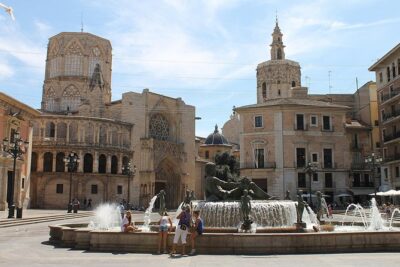
Valencia Old Town Tour with Wine & Tapas in 11th Century Historic Monument
Read our review →
Old Town Tour, Wine & Tapas in an 11th c. Monument
Read our review →
Barcelona Gothic Quarter Tapas & Taverns Food & Wine Tour
Read our review →
San Sebastian Old Town Pintxos & Wine Tour Small Group Tour
Read our review →
Madrid Historic Centre Food Tour with Authentic Tapas & Wines
Read our review →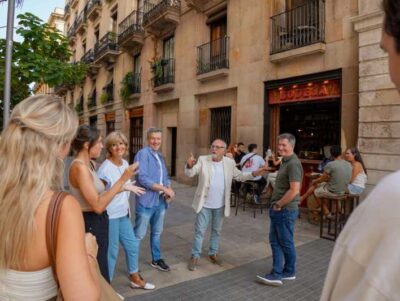
El Born and Gothic Quarter Wine & Tapas Bar Tour
Read our review →
Barcelona Old Town Tapas Tour: Vermouth, Bites & Hidden Gems
Read our review →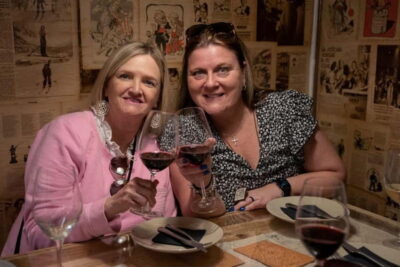
Barcelona Old Town Tapas Night: Hidden Bars, Cava & Vermut
Read our review →Browse the lists this tour appears in